Tabasco sauce sits in a category of its own. At a glance it feels simple—just heat, salt, and vinegar—but the way those elements are handled turns it into something much closer to a fermented, aged product than a typical hot sauce. Most sauces are blended and bottled quickly. Tabasco, on the other hand, takes its time, and that patience is really where its character comes from.
Everything starts with the peppers. Tabasco peppers, a variety of Capsicum frutescens, are harvested only when they reach a fully ripe, bright red stage. That detail matters more than it might seem. At full ripeness, the peppers are not just hotter—they are also slightly sweeter and more complex, which gives the final sauce a better foundation. Traditionally, ripeness has been checked visually using a small red stick, matching the pepper’s color to a precise shade. It sounds almost ceremonial, but it reflects how tightly controlled this first step is.
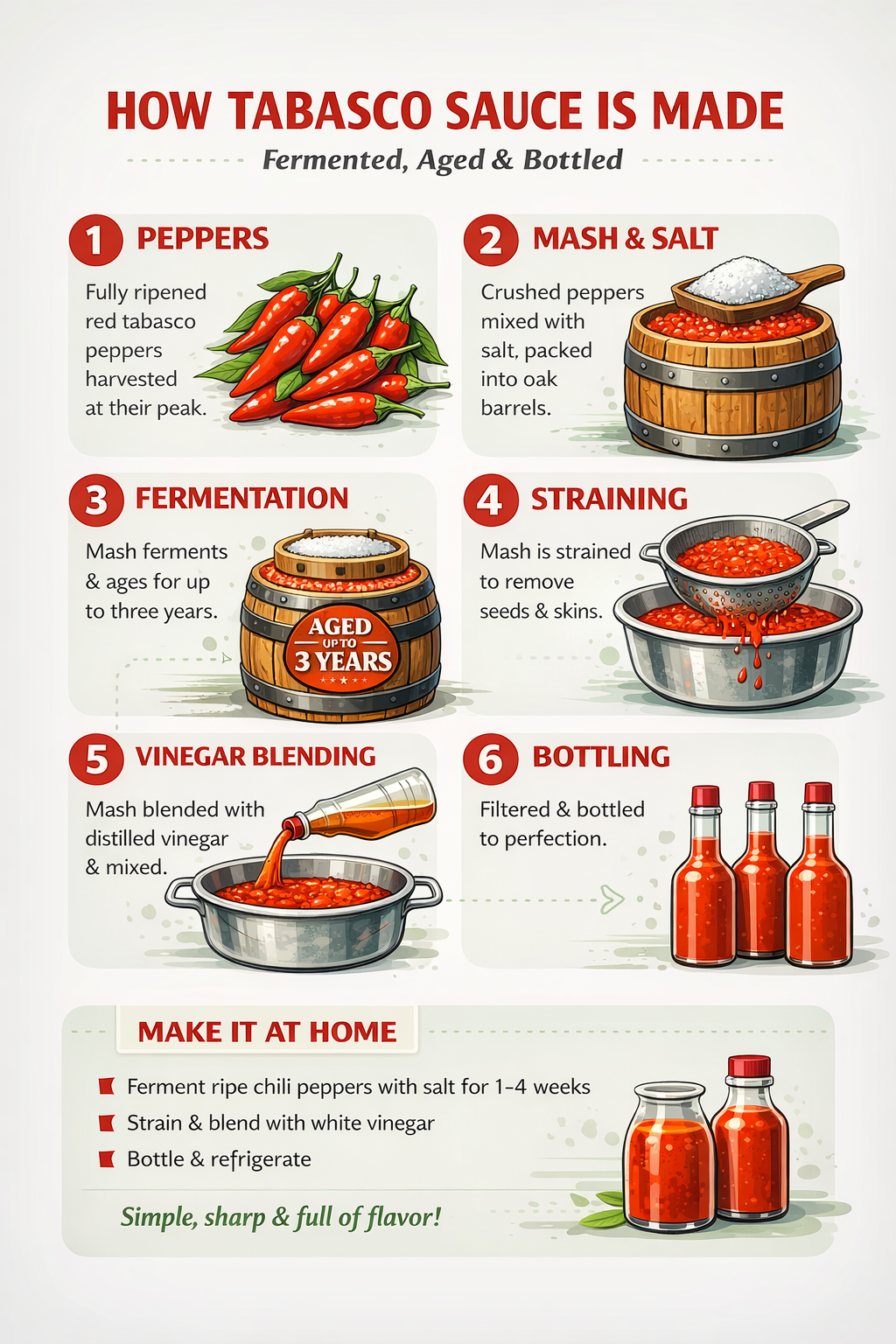
Once harvested, the peppers are crushed into a mash and mixed with salt. The salt is not just there for flavor. It plays a critical role in controlling fermentation, preventing unwanted microbial growth while allowing beneficial fermentation processes to take hold. The mash is then packed into barrels—historically white oak—and sealed with an additional layer of salt on top. That salt cap acts as a protective barrier during aging.
Then comes the part that really defines Tabasco: time. The mash is left to ferment and age, traditionally for up to three years. During this period, the peppers break down slowly, their sharp edges softening as fermentation develops acidity, depth, and a kind of subtle funk. The oak barrels also contribute in a quiet way—not in the obvious, vanilla-heavy sense of wine or whiskey aging, but as a gentle influence on texture and integration. The result is a mash that tastes older than it is, more layered, more cohesive.
After aging, the mash is removed from the barrels and strained. Seeds and skins are separated out, leaving behind a smooth, concentrated pepper base. At this stage, the flavor is intense and somewhat raw—fermented, salty, and deeply pepper-forward.
This is where vinegar enters. The aged mash is blended with distilled vinegar and then mixed or agitated for an extended period, often around a month. That step is not just dilution. The vinegar sharpens and stabilizes the sauce while also helping to integrate the fermented flavors into something more balanced and recognizable. It transforms the mash from an aged ingredient into a finished sauce. The texture becomes thinner, the flavor more focused, and the heat more precise.
Finally, the sauce is filtered and bottled. What ends up in the bottle is deceptively simple: a thin, bright red liquid with a sharp aroma and a clean, immediate heat. But behind that simplicity is a process that took years, not days.
Trying to recreate this at home is less about copying the exact method and more about understanding the principle. The key difference between a Tabasco-style sauce and a typical homemade hot sauce is fermentation. If you skip that, you get something fresh and punchy, but not the same depth.
A practical home approach starts with fully ripe red chili peppers—any suitable variety can work if tabasco peppers are unavailable. The peppers are blended into a mash and mixed with about three percent salt by weight. That mash is packed into a jar, pressed down to remove air pockets, and left to ferment at room temperature. The container should not be sealed airtight, since fermentation produces gas. Over one to four weeks, depending on temperature and taste preference, the mash will develop acidity and complexity.
Once fermented, the mash is strained to remove solids, then blended with white vinegar. A roughly equal ratio of mash to vinegar is a good starting point, though it can be adjusted. Letting the mixture rest for a few days—or even weeks—helps the flavors settle and integrate. The final sauce can then be bottled and refrigerated.
It will not replicate the full character of a three-year barrel-aged product, and that’s fine. What it does capture is the essence: a fermented pepper base sharpened with vinegar into something clean, bright, and enduring. That’s really the idea behind Tabasco. Not complexity through ingredients, but complexity through process.
Leave a Reply