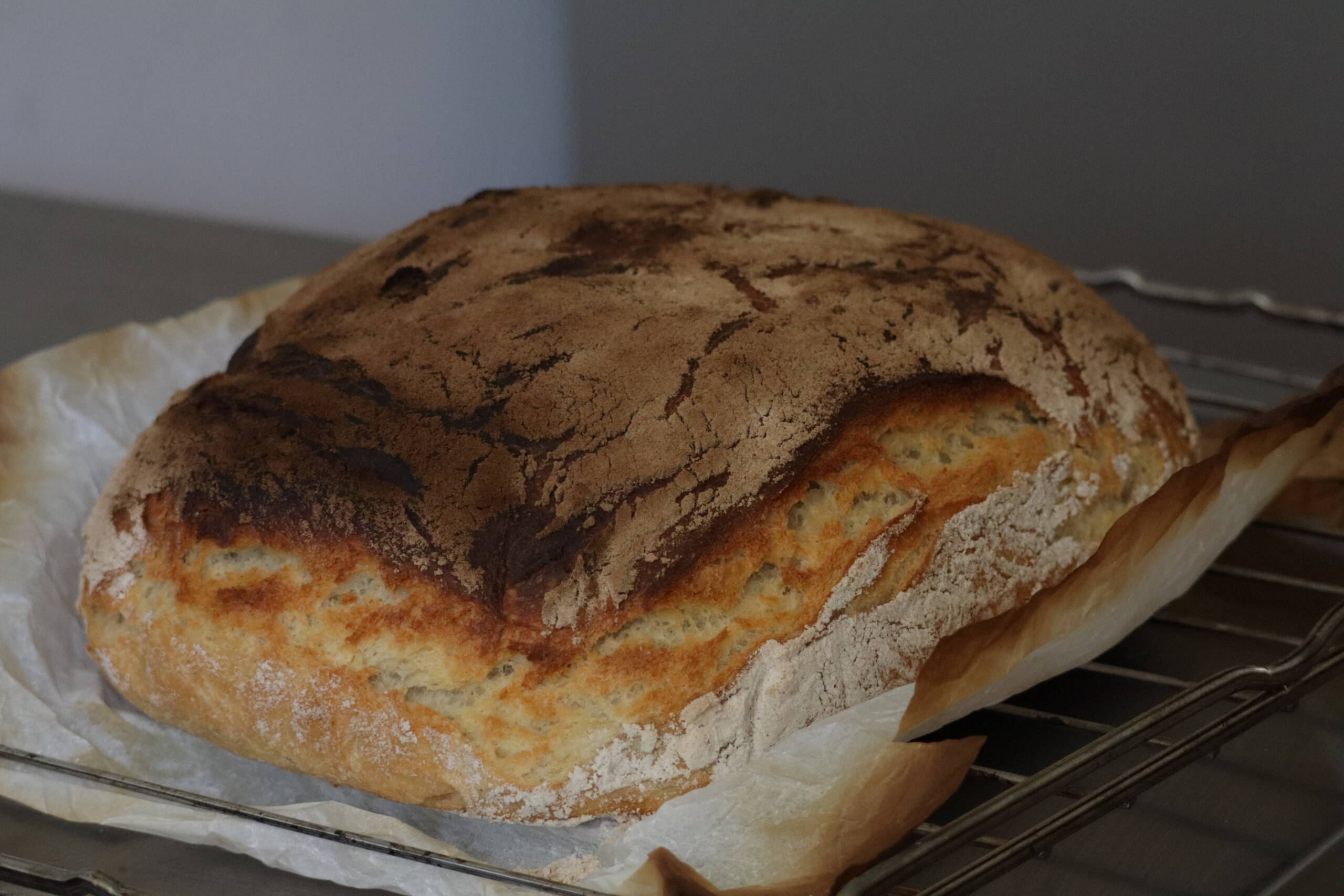
A loaf like this always carries a certain quiet drama the moment it comes out of the oven. The photograph captures that exact moment when bread is no longer dough but not quite finished revealing itself either. The loaf rests on a metal cooling rack, still perched on a sheet of wrinkled parchment paper that curls slightly at the edges, browned where it touched the hot baking surface. Its shape is broad and slightly irregular, the kind of oval dome that tells you this bread rose naturally rather than being forced into a pan. Flour dusts the crust in soft patches, giving the surface a pale, powdery look that contrasts beautifully with the darker baked areas.
Shot with the Canon RF 100–400mm F5.6–8 IS USM paired with the compact Canon R100
The crust itself is where the character of the bread truly appears. Deep golden tones run across the sides, while the top has cracked open in jagged, organic patterns that look almost like dried earth after a summer heatwave. In the center, a dramatic split exposes the lighter interior crumb where the dough expanded during baking. That expansion has created a thick ridge where the crust lifted and separated, revealing the airy structure inside. Some parts of the crust have charred slightly to a deep brown, not burnt but toasted just enough to hint at the intense heat of the oven. Bakers often chase exactly this look, because those darker patches usually mean the crust will shatter slightly when cut, giving that satisfying crunch.
The lighting in the image feels natural and calm, likely coming from a nearby window. Soft shadows fall along the curve of the loaf, emphasizing its volume and the uneven texture of the crust. The background fades into a simple grey wall, out of focus and intentionally plain, allowing the bread to dominate the frame. It feels like a quiet kitchen moment rather than a staged studio shot. You can almost imagine the smell still lingering in the room — warm flour, caramelized crust, and that unmistakable scent of freshly baked bread that makes people hover near the kitchen counter waiting for it to cool.
Details around the loaf reinforce that sense of immediacy. The parchment paper is slightly browned and folded back on the right side where it was peeled away from the hot baking vessel. The metal rack underneath suggests the bread has just been transferred to cool, an important step that lets steam escape and keeps the crust crisp. If you look closely at the lower edge of the loaf, you can see flour clinging to the dough where it was shaped and proofed before baking. That little detail gives away the handmade process behind it — this was not machine-perfect bread but something shaped by hands, fermentation, and heat.
Photographically, the composition works well because the loaf fills most of the frame while still leaving breathing room around it. The angle is low enough to emphasize the height and expansion of the bread, making the crust textures the star of the scene. For a food photograph, it’s refreshingly honest. No elaborate styling, no garnishes, just bread in its pure form, captured at the exact moment when the baker steps back and says, more or less, “yes… that worked.” And honestly, looking at the crackling crust and the color of that bake, it very much did.
Leave a Reply