There is something almost irresistible about a beautifully arranged pastry display. Rows of chocolate-covered spirals, delicate round cakes decorated with toasted hazelnuts, golden pastries coated in chopped nuts, and glossy creations finished with pistachio cream seem to compete for attention. Some look wonderfully rustic, others almost too perfect to eat. Yet they all share a quality that separates an ordinary sweet treat from a memorable pastry: the careful balance of texture, flavor, freshness, and craftsmanship.
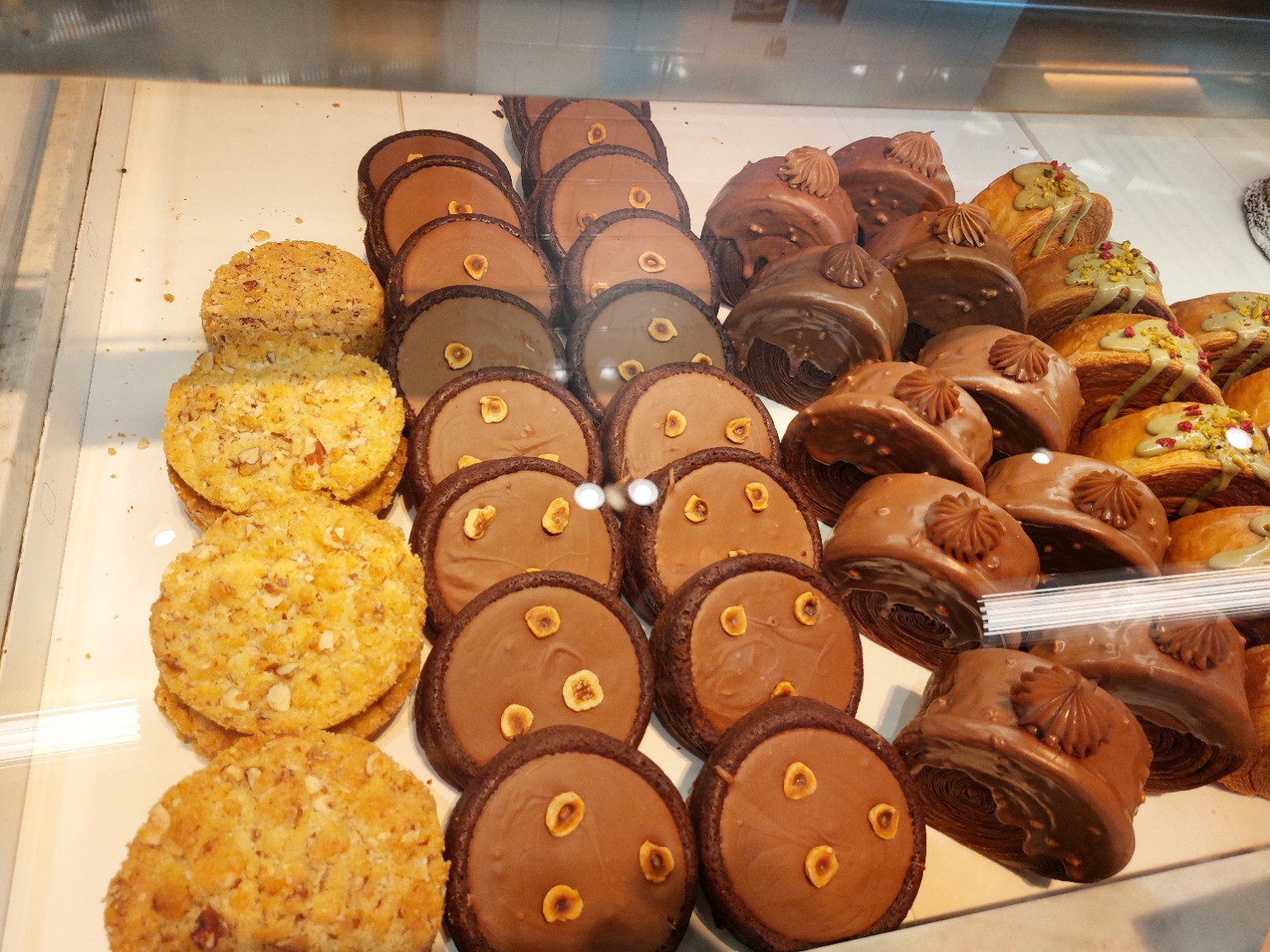
The photograph captures this beautifully. On the left, golden round pastries are covered with a generous layer of finely chopped nuts, giving them a rough, crunchy appearance. In the center, neat rows of chocolate pastries have smooth milk-chocolate surfaces, dark outer edges, and small pieces of toasted hazelnut arranged almost like miniature decorations. To the right, rich chocolate-coated laminated pastries reveal tightly wound layers beneath their glossy surfaces, while another group is decorated with pale green pistachio-colored cream and colorful nut fragments. And, frankly, choosing just one would be rather difficult.
But what actually makes a pastry perfect? Is it the quality of the butter, the skill of the baker, the temperature of the oven, or some closely guarded family recipe? The answer is less mysterious than we might imagine, although achieving perfection consistently is another matter entirely.
The first secret is understanding that pastry is a delicate negotiation between ingredients. Flour provides structure, butter contributes richness and tenderness, sugar influences sweetness, moisture, and browning, while eggs can add stability, color, and softness. Change the proportions slightly and the result can be completely different. A shortcrust pastry should crumble pleasantly rather than resist the teeth. A laminated pastry should have distinct, delicate layers that break apart with a gentle crunch. A chocolate filling should be smooth and rich without becoming heavy or excessively sweet. Good pastry is not simply about adding more butter, chocolate, or cream. It is about knowing when enough is enough.
Butter deserves particular attention. In many European pastry traditions, it is the ingredient that defines both flavor and texture. High-quality butter with an appropriate fat content can produce a remarkable difference, particularly in croissants, puff pastry, and delicate biscuits. But temperature matters just as much as quality. Butter that becomes too warm during lamination can merge into the dough instead of remaining in separate layers. Butter that is too cold may fracture when rolled. The baker must keep it pliable without allowing it to melt. This sounds straightforward until one attempts to produce dozens of perfectly layered pastries in a warm kitchen.
Temperature, in fact, may be the most underestimated ingredient in pastry making. Dough needs to rest, butter needs to remain within a suitable temperature range, chocolate must be tempered correctly when a crisp, glossy finish is desired, and ovens must deliver consistent heat. Even the temperature of a filling matters. A cream that is too warm can soften a crisp pastry shell, while a filling that is too cold may lose some of its aromatic appeal. Professional pastry kitchens often resemble small laboratories, with thermometers, scales, refrigeration equipment, and carefully controlled procedures. There is a good reason for that.
The chocolate pastries in the photograph illustrate another important principle: contrast. The smooth chocolate centers are framed by darker, slightly rougher pastry edges, while the toasted hazelnut pieces provide a visual promise of crunch. A successful chocolate pastry should offer more than sweetness. Ideally, it combines the richness of cocoa with a complementary texture, perhaps a crisp biscuit base, a tender sponge, or a delicate laminated structure. The hazelnuts add their own roasted character, making the chocolate taste more complex. This combination has endured for generations because it works extraordinarily well.
The golden nut-covered pastries offer a different kind of pleasure. Their irregular surfaces suggest a crumbly or crunchy texture, with toasted nuts contributing both flavor and aroma. Nuts are particularly useful in pastry because their natural oils carry flavor, while roasting develops deeper, warmer notes. Almonds, hazelnuts, walnuts, and pistachios can transform a relatively simple dough into something distinctive. But they must be handled carefully. Under-roasted nuts can taste flat, while over-roasted ones introduce bitterness. Freshness is equally important because the oils in nuts can eventually turn rancid.
Then there is the matter of sweetness. One of the clearest distinctions between an average pastry and an exceptional one is that the exceptional pastry rarely depends on sugar alone to make an impression. Sweetness should support the other flavors rather than overwhelm them. Dark chocolate introduces bitterness, toasted nuts contribute earthy richness, fruit can provide acidity, and a tiny amount of salt can make the entire composition more vivid. Even milk chocolate, often associated with pronounced sweetness, becomes more interesting when paired with roasted hazelnuts or a slightly salty pastry base.
Texture is perhaps the most immediate test of a baker’s skill. We experience it before we have time to analyze the flavor. A crisp shell that yields to a soft filling, a flaky exterior surrounding a tender center, or a smooth chocolate coating over a crunchy biscuit creates a sequence of sensations that makes eating a pastry interesting. This is why professional pastry chefs often combine several components rather than relying on a single homogeneous mixture. A pastry can contain a biscuit, a cream, a glaze, and a nut garnish, each contributing something different. The trick is making these components work together rather than turning the dessert into an unnecessarily complicated construction.
Freshness is another essential ingredient, and one that cannot be disguised indefinitely by attractive decoration. A laminated pastry is often at its best relatively soon after baking, when its layers remain crisp and aromatic. Filled pastries may have a shorter ideal serving window because moisture gradually migrates from creams and fillings into their surrounding shells. Chocolate coatings can protect certain components, but they cannot restore the original texture of a pastry that has been stored improperly. A beautiful display is appealing, but the real test begins with the first bite.
This brings us to a slightly uncomfortable truth about modern pastry making: appearance sometimes receives more attention than taste. Social media has encouraged elaborate decorations, dramatic colors, mirror glazes, and desserts engineered to look spectacular in photographs. There is nothing inherently wrong with that. Presentation has always been part of the pastry chef’s craft. But a perfect pastry should not need an elaborate visual performance to justify its existence. A simple, freshly baked butter croissant can be more satisfying than a complicated dessert assembled from ten components, particularly when those components contribute little beyond decoration.
The pastries in the photograph occupy an appealing middle ground. They are carefully arranged and decorated, but their visual attraction comes largely from familiar ingredients: chocolate, nuts, cream, and layered dough. The little hazelnut pieces on the round chocolate cakes are particularly charming. They are not extravagant, yet they give each pastry an identifiable character. The piped chocolate decorations on the spirals provide a similar finishing touch, while the pistachio-colored toppings introduce contrast without hiding the pastry beneath them.
Consistency is another hallmark of a skilled pastry chef. Producing one excellent pastry is an achievement, but producing fifty that look and taste nearly identical requires a different level of discipline. Dough thickness, portion weight, baking time, filling quantity, and finishing techniques must all be controlled. This is where professional training and repetition become invaluable. The baker develops an instinct for the feel of dough, the appearance of properly baked layers, and the precise moment when a cream has reached the desired consistency. Such intuition may look effortless, but it is usually the result of hundreds or thousands of repetitions.
And what about the home baker? Is perfection possible without professional equipment? Absolutely, although a few habits make an enormous difference. Weighing ingredients rather than relying on approximate volume measurements improves consistency. Allowing dough to rest prevents excessive shrinkage and makes it easier to handle. Preheating the oven thoroughly reduces unpleasant surprises. Using fresh nuts, good chocolate, and properly stored butter can elevate even simple recipes. Most importantly, following the process patiently is usually more valuable than searching for exotic ingredients or complicated techniques.
One of the great pleasures of pastry making is that small improvements accumulate. A slightly better chocolate, more careful temperature control, a few additional minutes of dough resting, or a more restrained approach to sugar can transform a familiar recipe. The baker gradually learns not only what works, but why it works. That knowledge is the real secret, far more useful than any single recipe.
Ultimately, the perfect pastry is not necessarily the most expensive, the most elaborate, or the most photogenic. It is the one that delivers exactly what its appearance promises: a pleasing texture, balanced flavors, fresh ingredients, and a sense that somebody cared about every detail. Sometimes that means a magnificent chocolate creation with multiple layers and carefully tempered coating. Sometimes it means a humble nut-covered biscuit that crumbles beautifully and tastes of freshly roasted almonds.
For home bakers who want to improve consistency, a digital kitchen scale, an instant-read kitchen thermometer, a rolling pin, and a bench scraper are practical tools worth considering. None replaces technique, but each can make careful pastry work easier to repeat.
And sometimes, standing in front of a display like the one in the photograph, perfection means admitting that the only reasonable solution is to try two.
Affiliate disclosure: As an Amazon Associate I earn from qualifying purchases.