The fluted tin with the loose bottom is what most home bakers own, and it’s what most of us blame when a tart shell comes out pale underneath and slumped at the sides. The tin isn’t useless. It’s just a design built around blind baking, beans, foil and a lot of hope.
Pastry shops mostly don’t use it. They use plain rings, often perforated, sitting on a perforated mat. The shell bakes evenly, the sides stand straight, and the base browns without a soggy middle.
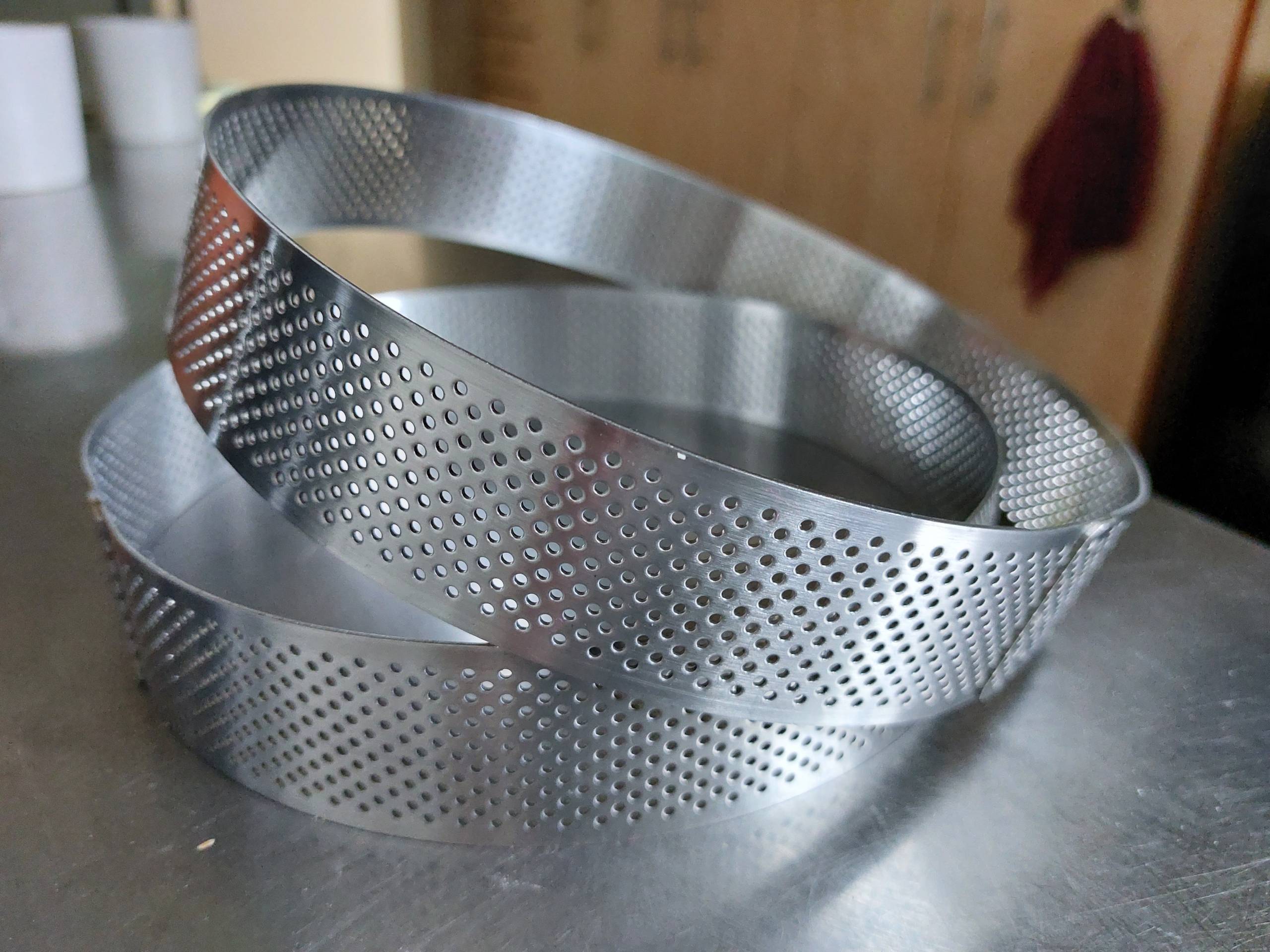
We’ve covered the method in detail in our foolproof tart shell with a perforated tart ring. This is the buying side of it: what the ring does, which one to get, and what else you need.
Holes Let the Steam Out
Pastry goes soggy because water has nowhere to go. In a solid tin, the steam from the butter and the dough gets trapped against the metal and the sides cook in it. A perforated ring is full of tiny holes, so the steam escapes and hot air reaches the pastry from the sides and, with a perforated mat, from underneath too.
The result is a shell that colours evenly all over. For a sweet pastry shell, you often don’t need to blind bake with weights at all. The dough is pressed thin enough and dried out fast enough that it holds its shape on its own.
The other win is the straight wall. A plain ring gives you clean, vertical sides that look professional and slice cleanly, without the fluted edge catching and cracking when you unmould.
Which Ring to Buy
The reference ring is the de Buyer Valrhona perforated tart ring, made in France from stainless steel and developed with the chocolate maker’s pastry school. It comes in two heights, 3.5 cm for classic tarts and 2 cm for shallow ones, and in diameters from small tartlet sizes up to 28.5 cm. The finish is good and the edges are rolled, which matters when you’re pushing dough into them with your thumbs.
If you’re starting out, a 20 cm ring at 2 cm high is the most useful single size. It’s right for a family-sized fruit tart or a lemon tart, and the shallow wall makes it forgiving with pastry thickness. Add a set of tartlet rings later if you get hooked.
Cheaper perforated stainless steel tart ring sets are widely sold too. Most work fine. Check that the stainless is thick enough not to bend when you press the dough in, and that the cut edges are smooth rather than sharp.
The Mat Matters as Much as the Ring
A perforated ring on a solid baking sheet loses half the benefit, because the base still steams. Put it on a perforated silicone baking mat on top of a wire rack or a perforated tray. The mesh lets air through underneath and the pastry bottom crisps the way the sides do.
Demarle’s Silpain is the professional version of this mat and lasts for years. Generic perforated mats are cheaper and do the same job at home.
How to Line It Without Tears
Roll the dough to about 3 mm and chill it until it’s firm but still bendable. Cut a disc for the base slightly smaller than the ring, then cut a strip for the sides, the height of the ring and a little longer than its circumference. Set the base in, wrap the strip around the inside wall, and press the seam and the bottom edge together with your thumb.
Chill it again before baking. Then trim the top with a small sharp knife, held flat against the rim, once the shell has baked and cooled a little. That’s how you get the clean edge you see in pastry shop windows.
Bake at a moderate heat, around 160 to 170°C with fan. Lower and slower than you’d think, until the shell is evenly golden. Our cherry tart with crème pâtissière is a good first filling once you have the shell right.
Keep the Fluted Tin for Quiche
A deep fluted tin still has a place. Savoury tarts with a wet custard filling, like quiche, need the solid base to stop the liquid leaking out. For everything sweet, the ring wins.
It’s one of those small purchases that makes your baking look more expensive than it is.
As an Amazon Associate I earn from qualifying purchases.