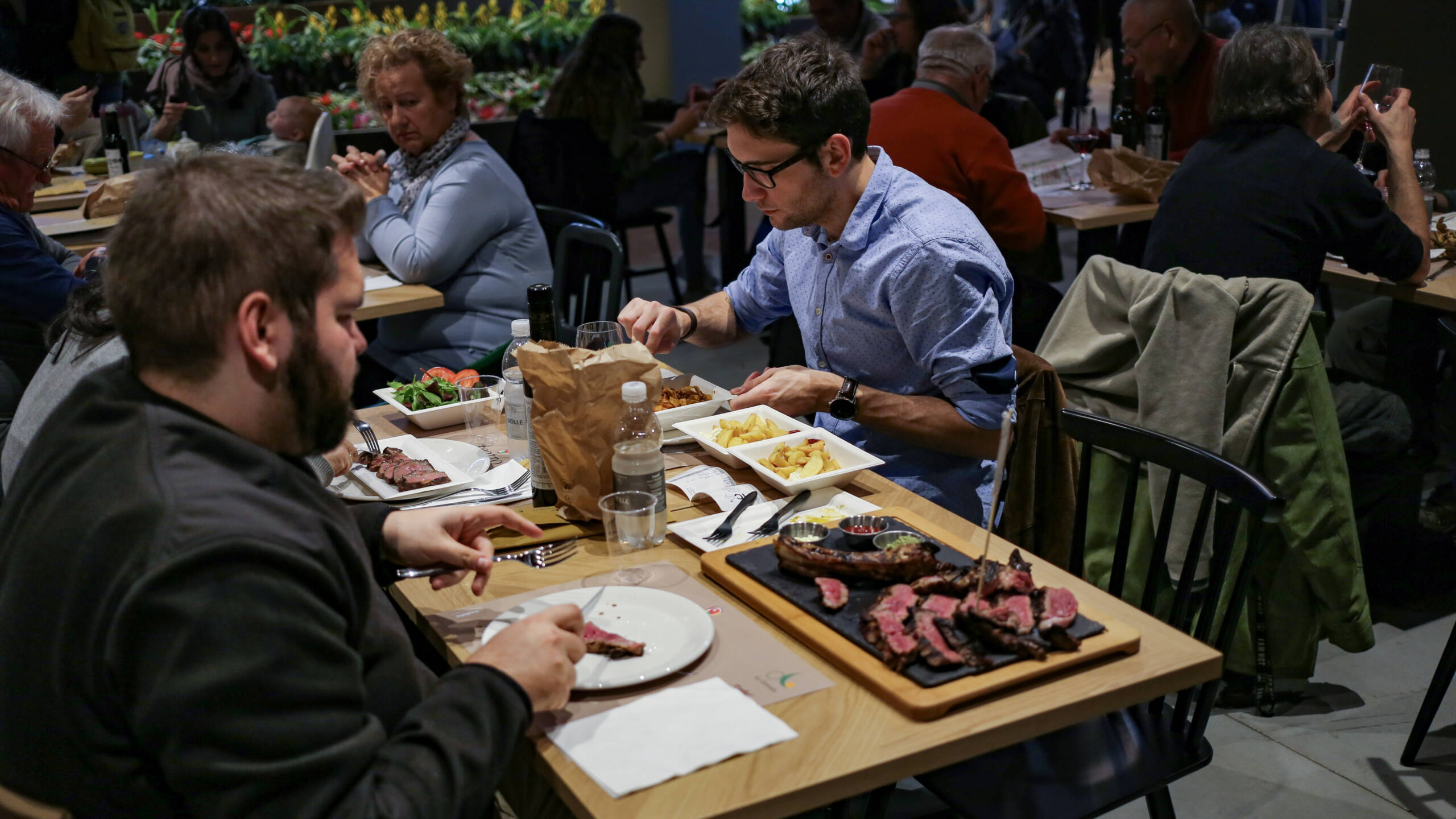
Two men, one board, about a kilo of beef between them. The steak has already been carved off the bone and fanned across hot slate, the bone parked at the back like a trophy, two dishes of fries alongside and a plastic fork to eat it with. This is what bistecca looks like in an Italian market hall in 2026, and most of what happens to it after it leaves the grill is a compromise.
Some of those compromises are fine. One of them is quietly ruining the steak.
It Is a Cut Before It Is a Recipe
Bistecca alla fiorentina is not a cooking method with a name attached. It is a specific piece of the animal, cut a specific way, and everything else follows from that.
You want the lombata, the loin section, cut across the bone so the T shape holds two muscles at once. Tenderloin on the short side, strip loin on the long one. Thickness is not negotiable: three fingers, four to five centimetres, which puts a single steak somewhere between a kilo and a kilo and a half. Traditionally the animal is Chianina, the enormous white Tuscan breed, though Maremmana turns up too and plenty of restaurants quietly use neither.
The thickness is the entire point. A steak that thick can take fierce heat from embers on both sides and still hold a raw-ish, cool core, which is what the dish is supposed to be. Cut it thinner and you no longer have a bistecca. You have a T-bone, which is a perfectly good thing to eat and a completely different experience.
Because it weighs a kilo, it is shared. Because it is shared, it gets sliced. That is where the trouble starts.
Sold by the Etto, Which Explains the Receipt
The paper receipt sitting on the table in that photo arrives before the food, and that is normal. Bistecca is priced per etto, per hundred grams, and the piece is usually weighed in front of you or at least logged at the counter. You are not ordering a portion. You are buying a quantity of beef, which is why most places set a minimum, and why the bill is a genuine surprise to anyone who has not done the arithmetic on 1.2 kilos.
The market-hall format leans into this. Counter, scale, ticket, communal table. It is closer to a butcher’s shop that lets you sit down than to a restaurant, and it accounts for the disposable cutlery and the paper napkins as well. Nobody is polishing a knife for you.
Slate Holds Heat, and Heat Keeps Cooking
Here is the part worth complaining about.
A hot slate or stone board is a service trick, and it works against a rare steak. The meat comes off the grill already carrying carryover heat. Slice it, lay the cut faces flat on a surface that has been sitting under a heat lamp or straight off the pass, and every one of those exposed surfaces keeps cooking. The rare interior you paid for turns pink at the edges within a few minutes and grey soon after.
The reverse failure is just as common. Cold slate, in a cold room, and the fat on a fiorentina goes waxy fast. Beef fat starts firming up well before the plate feels cold to the hand, and once it does, the texture is gone.
Neither problem is severe if you eat quickly. Both are unnecessary. A warm wooden board does the job with none of the extremes, which is what the piece under the slate in that picture actually is.
Slice at the Table, Not Behind the Pass
The kitchen slices ahead because it is faster and because it makes a photogenic fan of meat. The cost is that the steak is exposed to air, to hot stone and to the room for the entire meal instead of for the minute before it is eaten.
If the place will do it, ask for the steak whole, off the bone or on, and carve as you go. If it will not, eat the outer slices first and let the middle sit where it is. The classic move of standing the bistecca on its bone for the last minute of cooking exists for the same reason: keep the cut surfaces off the heat until the last possible moment.
Salt is a related argument. Purists salt after the steak comes off the grill, sometimes only once it is sliced, using coarse salt on the cut face. Olive oil goes on at the end and never in the pan or on the grill. If a place brings the steak already dressed and already sitting in its own juice on a hot surface, they have made three decisions for you and none of them were in your favour.
Fries Are a Food-Hall Invention
The two dishes of fries in that photo are not traditional. They are what a market hall serves because a fryer is fast and everyone orders them.
The actual Tuscan sides are simpler and better with this cut. Cannellini beans with good oil and pepper, or fagioli all’uccelletto with tomato and sage. Roast potatoes with rosemary. Sautéed spinach or chard with lemon. All of them exist to sit under the meat juices, and fries do not, because fries go soggy in about ninety seconds.
Wine follows the same logic. Sangiovese, in whatever form the region gives you, Chianti Classico or a Morellino. Nothing that has been in new oak for two years.
The Short Version
Order it rare and mean it. Ask whether it comes sliced, and if it does, ask for it sliced at the table. Salt it yourself. Skip the fries. Eat the meat nearest the bone before anyone else works out that it is the best part.
And if they bring it out on a stone that is hotter than the room, eat faster.
As an Amazon Associate I earn from qualifying purchases.