At first glance, the little parcels on the counter could pass for sweets waiting to be wrapped. Their deep pink centers sit between pale yellow ends, each piece pinched and twisted into something resembling a candy wrapper. Then the rest of the scene comes into focus: flour scattered across a broad work surface, shallow metal trays crowded with more parcels, and two cooks working behind glass in a white-tiled kitchen. This is pasta with a playful streak, caught at the stage when dinner still looks a little like a craft project.
The photograph rewards a slow look. In the foreground, the parcels lie in loose groups across the flour-dusted counter, their differences in length and shape giving away the handwork involved. Some have broad, flattened yellow tails; others curl inward at the ends. The pink middle sections stand out against the pale surface, repeating the colors of the pasta stacked in the trays to the left. Behind them, a cook in a black cap, white jacket, and dark striped apron works a mound of yellow mixture inside a large rectangular tub. His gloved hands are caught mid-motion, gathering and pressing it together. Beside him, another cook stands at a bright green basin resting on a scale. Stainless steel refrigerators, shelves of containers, and two dark horizontal stripes running through the tiled wall complete the picture. Even the reflections in the glass contribute something: you feel the small distance between watching the kitchen and being inside it.
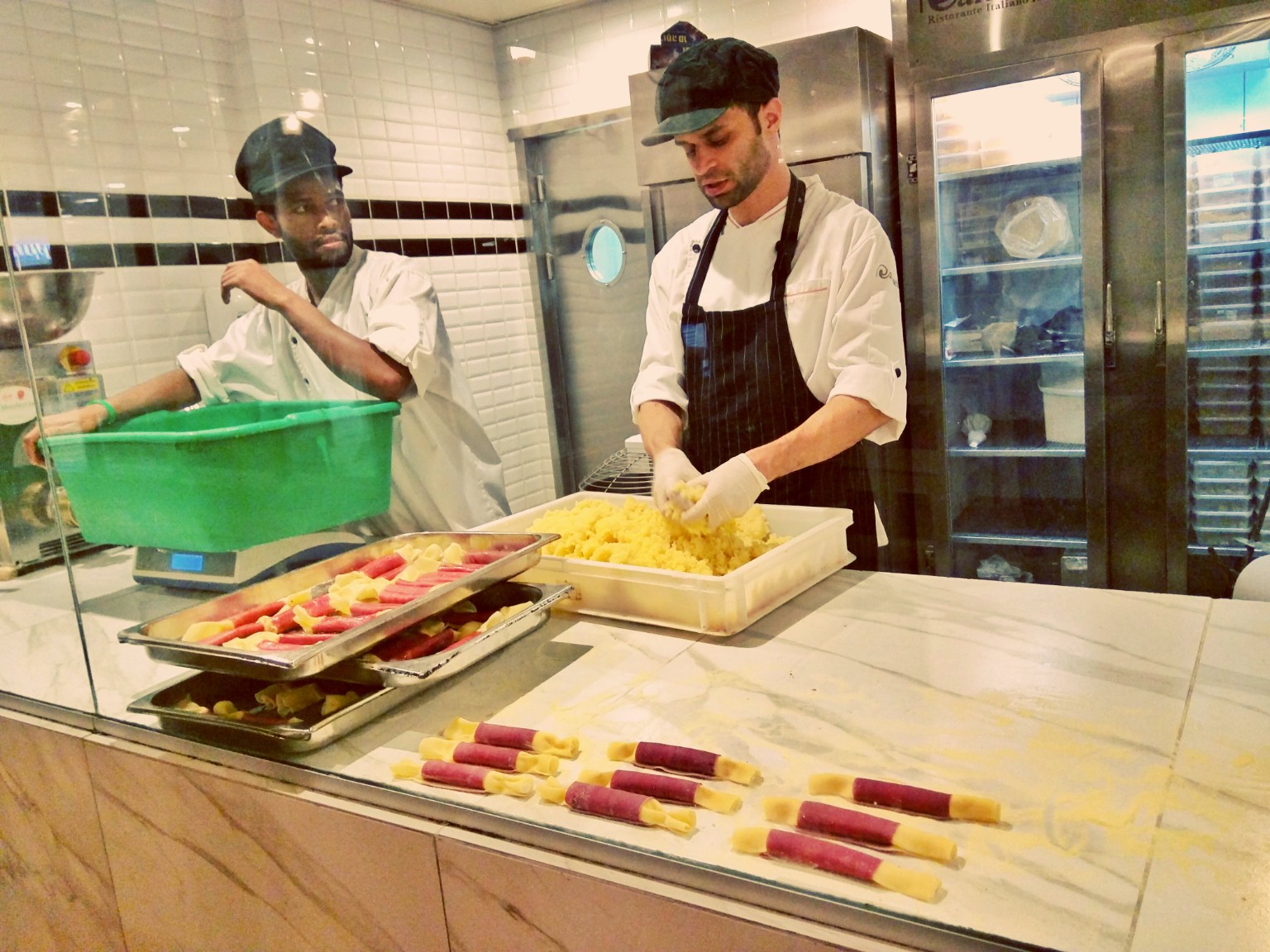
Candy-wrapper pasta shapes are often called caramelle, and the resemblance makes the name easy to remember. Here, the two colors turn that familiar wrapping gesture into the main attraction. The photograph alone cannot tell us what produces the pink shade or what is tucked inside each parcel, tempting though it is to guess. What it does show is how much character can come from the construction itself. A contrasting strip of dough, a rounded center, two twisted ends, and suddenly a tray of fresh pasta has a personality.
There is a particular pleasure in seeing food before it reaches the plate. The flour is still on the counter, the batches are still accumulating, and the cooks have plenty left to do. You can follow the repeated gestures through the finished pieces without needing a demonstration. These little pink and yellow parcels make a good case for watching the kitchen for another minute or two. The sauce can wait; there is already quite a lot to enjoy.