Some of the best dishes in Spanish cuisine are almost embarrassingly simple. Pimientos de Padrón, the small green peppers traditionally served blistered in olive oil and sprinkled with coarse sea salt, are a perfect example. No complicated sauce, no elaborate presentation, no culinary theatrics. Just peppers, heat, oil and salt. And yet, put a plate of them on a table with a cold drink, and they have a remarkable tendency to disappear before anything else arrives.
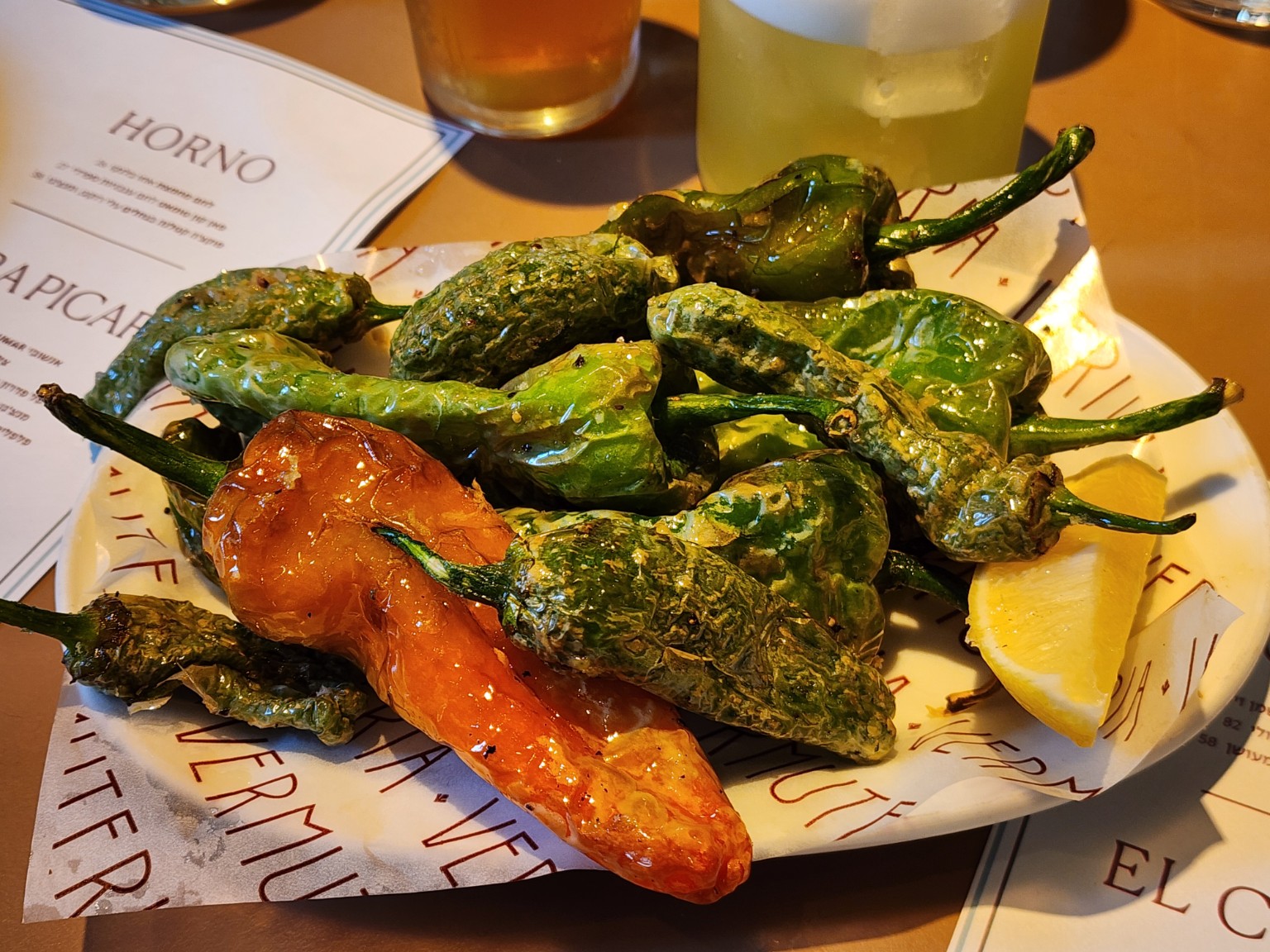
The photograph captures precisely that appeal. A generous pile of roasted peppers fills a white plate lined with printed restaurant paper, their skins wrinkled, glossy and unevenly blistered from cooking. Most are green, ranging from bright olive to deep, almost blackened green, while one conspicuously orange-red pepper stretches across the foreground. Two lemon wedges sit at the edge of the plate. In the background, drinks and a menu marked HORNO complete the scene of an informal tapas meal. It is not especially tidy food, and that is part of its charm. The peppers look as though they have come straight from a very hot pan, exactly as they should.
Padrón peppers take their name from Padrón, a municipality in Galicia, northwestern Spain, where their cultivation became a local tradition. The peppers are generally harvested while still small and green, before full maturity. Their thin skins and relatively delicate flesh make them particularly suitable for quick cooking at high temperatures. A few minutes in hot olive oil, or on a hot griddle, are enough to collapse the flesh slightly, blister the surface and bring out a gentle sweetness with a pleasantly vegetal, occasionally smoky flavor.
But there is another reason these peppers became famous. The traditional Galician saying, “Os pementos de Padrón, uns pican e outros non,” translates roughly as “Padrón peppers: some are hot and others are not.” Most are mild, but occasionally one delivers an unexpected burst of heat. The variation depends on growing conditions, maturity and other factors, and modern cultivation has generally made the peppers more consistently mild. Still, the possibility of encountering a fiery specimen remains part of their folklore. Eating a shared plate becomes a small culinary lottery, with everyone quietly wondering who will get the hot one.
What makes the dish particularly interesting is how little it needs. Good olive oil contributes richness, salt sharpens the flavor, and the blistered skin provides a contrast to the soft flesh underneath. Lemon is not essential to the traditional preparation, but the wedges in this photograph make sense: a little acidity can cut through the oil and refresh the palate. The orange-red pepper is also a reminder that peppers are living agricultural products, not standardized green objects. As they mature, their color, sweetness and sometimes heat can change.
Pimientos de Padrón also illustrate something fundamental about tapas culture. A tapa does not need to be a miniature gastronomic masterpiece. It can be a simple ingredient, prepared well and placed in the middle of the table for everyone to share. The social experience matters almost as much as the food itself. Someone reaches for another pepper, someone else comments on the salt, and eventually somebody gets a surprisingly spicy one. Conversation follows naturally.
There are plenty of sophisticated Spanish dishes worth traveling for, but a plate of Padrón peppers makes a persuasive argument for culinary restraint. Start with an interesting ingredient, cook it quickly, season it generously and leave it alone. Sometimes that really is enough.