At Palermo’s Ballarò market, food is not an abstract culinary concept. It is something prepared, assembled and sold right in front of you, often using recipes that have been part of everyday life for generations. This photograph captures one of those moments: a street-food vendor in a white apron and blue gloves preparing a sandwich filled with tripe, while customers gather around his stall. He holds a bread roll in one hand and works on the filling with the other. Behind him, an older customer watches closely, while the colorful patterned cloth covering the counter and the improvised market surroundings add to the atmosphere.
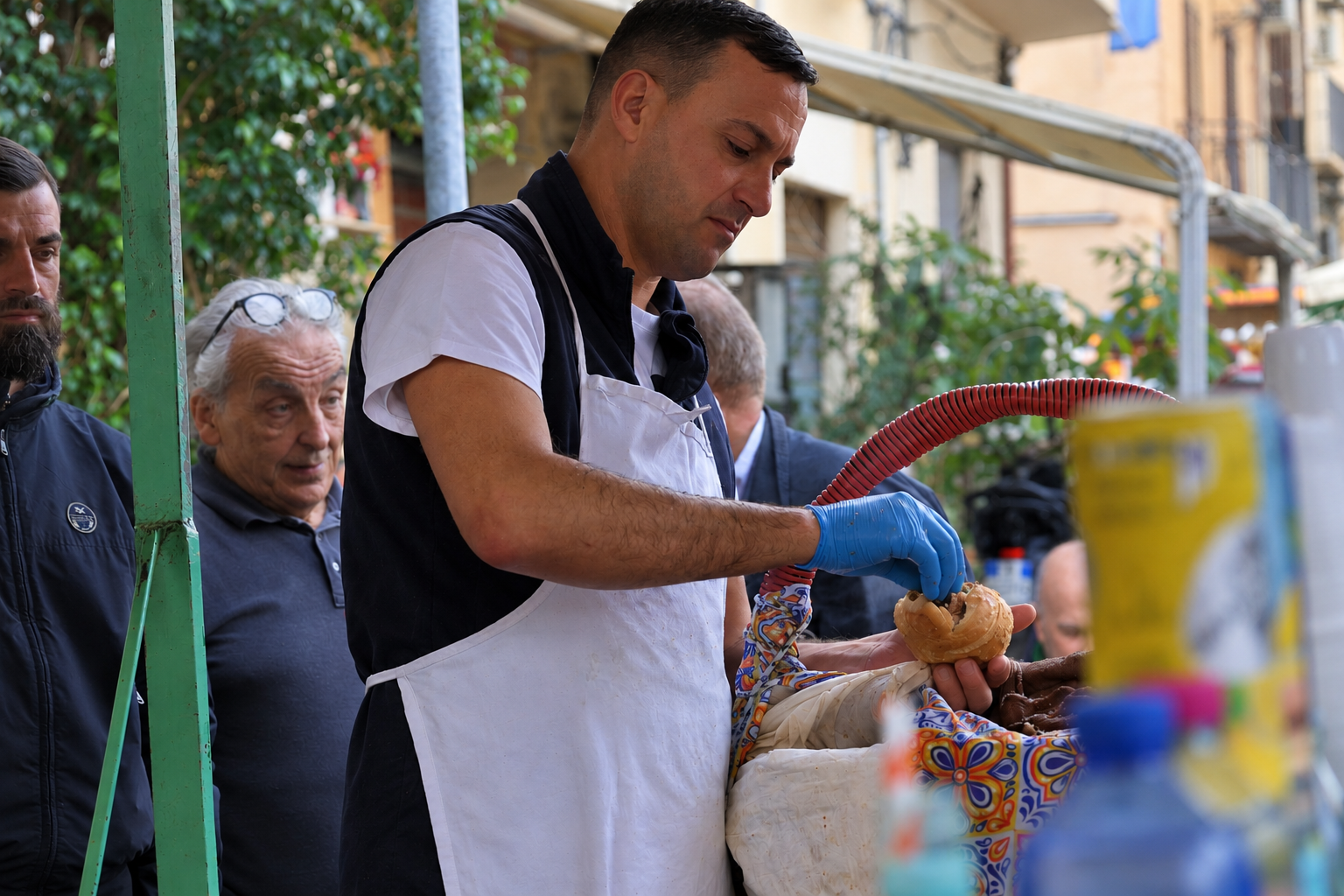
Ballarò is one of Palermo’s historic markets, in the Albergheria neighborhood. It is a noisy, crowded and wonderfully diverse place, where food stalls sit alongside produce sellers, spice merchants and small shops. The market is famous for its street food, including panelle, crocchè, sfincione, boiled octopus, stigghiola, frittola and the celebrated pani câ meusa, a sandwich made with veal spleen and lung. Tripe is another part of Palermo’s offal tradition, appearing in preparations such as quarume, a slow-cooked mixture of veal offal and tripe served hot. The sandwich in this photograph belongs to that same tradition of making delicious, inexpensive food from ingredients that other culinary cultures sometimes overlook.
There is something particularly appealing about this kind of street food. No elaborate presentation, no carefully arranged restaurant plates, no unnecessary ceremony. Just bread, a generous filling and a vendor who knows exactly what he is doing. The customer can watch the entire preparation, and the meal is ready to eat almost immediately.
But Palermo is only one stop in a much bigger culinary story. Almost every food culture has developed its own way of putting something delicious inside bread, folding it into flatbread, enclosing it in pastry or wrapping it in another edible layer. These foods are practical, portable and endlessly adaptable. Some are famous internationally, while others remain closely connected to a particular city, neighborhood or market.
The classic sandwich and its many variations
The conventional sandwich, with ingredients placed between two slices of bread, is only the beginning. Britain’s sandwich tradition has inspired countless variations, from simple cheese sandwiches to elaborate multilayer creations. Italy has the tramezzino, a soft crustless triangular sandwich, and panini, generally made with Italian bread and often pressed or grilled. Focaccia sandwiches use olive-oil-rich bread, while ciabatta offers a chewy, open-textured alternative. France contributes the baguette sandwich, croque-monsieur, a hot ham and cheese preparation, and the tartine, an open-faced slice of bread with savory or sweet toppings.
Spain’s bocadillo deserves particular attention. Usually made with crusty baguette-style bread, it can contain jamón, cheese, tortilla española, pork or other ingredients. It is an everyday food with an impressive range of regional variations. The Vietnamese bánh mì is another remarkable example, combining a light baguette with ingredients such as grilled meat, pâté, pickled vegetables, coriander and chili. It reflects a fascinating meeting of culinary traditions.
In the United States, the submarine sandwich, sub, hoagie and hero all describe variations of long filled rolls. Regional specialties include Louisiana’s po’ boy, New England’s lobster roll, New Orleans’ muffuletta, the club sandwich, Reuben and pulled-pork sandwich. Cuba and Cuban-American communities have contributed the Cuban sandwich and medianoche, while Uruguay has its substantial chivito and Chile its chacarero. Mexico has the torta, usually assembled in a bolillo or telera roll, and the cemita, particularly associated with Puebla and its sesame-covered bread.
Portugal offers the bifana, filled with seasoned pork, the prego steak sandwich and the elaborate francesinha. Argentina and Uruguay have choripán, a grilled chorizo sausage served in bread. Scandinavia takes a different approach with the Danish smørrebrød, an open-faced rye sandwich often topped with fish, meat, eggs, vegetables and sauces. Finland has voileipä, while Norway has its own tradition of open sandwiches with seafood and cold cuts.
Pita pockets and Middle Eastern flatbreads
Pita is one of the world’s most recognizable forms of filled bread. Its characteristic pocket makes it particularly suitable for meat, vegetables, sauces and salads. The Greek gyros pita combines sliced or shaved meat with tomato, onion, tzatziki and often potatoes. Across the Middle East, pita is used for falafel, shawarma and countless other fillings.
Israel has a particularly rich pita-based street-food culture. Sabich, with fried eggplant, hard-boiled egg, salad, tahini and amba, is an excellent example of how a relatively simple bread can become a complete meal. Falafel pita is another classic combination. The Levantine arayes takes the idea further: pita is stuffed with seasoned minced meat and grilled until the bread becomes crisp and the filling cooks inside. Manakish, meanwhile, is a flatbread traditionally topped with za’atar, cheese or other ingredients.
Laffa, associated with Iraqi and Israeli food traditions, is a large, soft flatbread particularly suited to wrapping around shawarma, kebabs and salads. Saj bread is another thin flatbread used for wraps throughout the region.
Turkish breads, wraps and filled specialties
Turkey has an especially diverse collection of bread-based foods. Döner kebab can be served in a roll, inside bread or wrapped in thin flatbread. Dürüm is the familiar rolled version, while yufka and lavash provide flexible wrappers. Gözleme is a thin flatbread folded around fillings such as cheese, spinach, potatoes or minced meat, then cooked on a griddle. Bazlama, a thicker bread, can also be used for sandwiches.
Turkish pide is a boat-shaped bread that may be filled with cheese, meat and vegetables. Lahmacun is a thin flatbread topped with seasoned minced meat and herbs, commonly rolled with fresh vegetables and lemon before eating. These foods demonstrate that the distinction between a sandwich, a wrap and a stuffed bread is not always clear-cut.
Indian and South Asian rolls
South Asia has developed an impressive vocabulary of stuffed and rolled foods. The kati roll from India uses a flatbread, commonly paratha, wrapped around meat, vegetables, eggs or paneer. The Frankie is another popular Indian street-food roll, often filled with spiced ingredients and chutneys. Paratha rolls, roti wraps and naan wraps are variations on the same practical idea. Kulcha can also be stuffed or used as a base for sandwiches.
Bolani from Afghanistan is a thin stuffed flatbread, usually filled with potatoes, herbs or vegetables. Qutab from Azerbaijan is another thin folded flatbread, often containing meat, cheese or greens. Dosa rolls from South India use a fermented rice-and-lentil crepe, while the dosa itself can be filled with spiced potatoes or other preparations.
Tortillas and the Mexican family of filled foods
The tortilla is perhaps the world’s most versatile food wrapper. Mexican cuisine has developed numerous ways to fold, roll, stuff and grill it. A taco is a folded tortilla containing meat, fish, beans, vegetables or other fillings. A burrito uses a larger tortilla wrapped around a substantial filling, often including rice, beans, meat and sauces. Quesadillas are folded tortillas with cheese and sometimes additional ingredients. Enchiladas are filled tortillas covered in sauce, while chimichangas are fried stuffed burritos.
Flautas and taquitos are rolled tortillas, typically fried until crisp. Tlayudas are large Oaxacan tortillas served with various toppings and sometimes folded. Gorditas use thicker corn dough, often split and stuffed. Tlacoyos are oval-shaped stuffed masa cakes, and huaraches are elongated masa bases topped with beans, meat, cheese and other ingredients. Outside Mexico, Tex-Mex cuisine has popularized fajita wraps and numerous tortilla-based combinations.
Stuffed breads, calzones and savory pastries
Not every filled food is technically a sandwich. Some are completely enclosed in dough, creating a portable meal that can be baked, grilled or fried. Italy contributes calzone, a folded pizza dough pocket, and panzerotto, a smaller stuffed dough preparation that is frequently fried. Both can contain tomato, mozzarella, meat and vegetables.
Spain and Latin America have empanadas, pastry turnovers with fillings that vary enormously by region. Argentina, Chile, Colombia and many other countries have their own recognizable versions. Britain has the Cornish pasty, a pastry pocket traditionally filled with meat and vegetables. Eastern Europe offers pirozhki, small baked or fried stuffed breads, and pirog, a larger filled pie.
Turkey and the Balkans share numerous börek traditions, using layered, folded or rolled pastry with cheese, spinach, minced meat or potatoes. The Middle East has sambousek and fatayer, while South Asia contributes the famous samosa. Other examples include the Eastern European knish, the German-influenced bierock and Nebraska’s Runza, both of which enclose savory fillings inside bread dough. Jamaica has its spiced meat patty, and Brazil has pastel, a fried pastry that can contain meat, cheese or other fillings. Georgia’s khinkali and the dumplings of Central Asia and Turkey, including manti, take the concept into another category: small parcels of dough enclosing a filling.
Buns, burgers and split rolls
The hamburger is probably the most internationally recognizable example of a filled bun. Its basic format, a split bread roll containing a patty and accompanying ingredients, has inspired endless variations. The cheeseburger adds cheese, while the hot dog places a sausage inside a long bun. American comfort food includes the sloppy Joe, filled with seasoned minced meat, and the pulled-pork sandwich, made with slow-cooked shredded pork.
China has baozi, steamed buns containing meat or vegetables, and mantou, steamed bread that can be used in different ways. Taiwan’s gua bao is a particularly attractive example: a folded steamed bun commonly filled with braised pork belly, vegetables and peanuts. Japan has nikuman, steamed buns containing savory fillings, and anpan, a sweet filled bread traditionally containing red bean paste. Malaysia contributes roti John, an omelette-filled baguette-style sandwich, while Singapore and Malaysia have kaya toast, often prepared as a sandwich with coconut jam and butter.
Brazil has pão com linguiça, sausage served inside bread, while the broader Portuguese-speaking world has numerous variations of meat-filled rolls.
Open-faced sandwiches and bread with toppings
Some food cultures prefer to place ingredients on top of bread rather than enclose them. Italy’s bruschetta is toasted bread with toppings, often tomatoes, garlic and olive oil. Crostini are smaller toasted pieces served with a variety of ingredients. France has tartines, which can be sweet or savory. Spain’s pan con tomate combines bread with ripe tomato and olive oil. Wales has Welsh rarebit, toasted bread covered in a savory cheese preparation.
The Scandinavian smørrebrød deserves special mention because it can become a carefully composed meal, combining rye bread with fish, meat, eggs, herbs and sauces. Avocado toast is a more contemporary international example of the same open-faced format.
Rice, pancakes and alternatives to bread
The wider family of filled and portable foods extends beyond wheat bread and flatbreads. Japan has onigiri, rice balls that can contain fish, vegetables or other fillings, and onigirazu, a rice sandwich wrapped in nori seaweed. Hawaii’s musubi, influenced by Japanese food traditions, combines rice and fillings, often with a strip of nori. Korea has kimbap, rice and various ingredients rolled in seaweed.
China contributes jianbing, a savory breakfast crepe folded around fillings, and stuffed or layered scallion pancakes. Vietnam’s fresh summer rolls use rice paper to enclose vegetables, herbs, noodles and protein. Southeast Asia also has popiah and lumpia, which use thin wrappers around cooked or fresh fillings.
Ethiopia and Eritrea have injera, a fermented flatbread used both as a base for food and as an edible utensil. It can be folded or rolled around various preparations.
Latin America offers some particularly interesting alternatives. Venezuela and Colombia have arepas, corn cakes that can be split and filled. Venezuela also has cachapas, sweet corn pancakes often folded around cheese. El Salvador has pupusas, thick stuffed corn flatbreads. These are not sandwiches in the conventional sense, but they belong to the same broader culinary family.
A world of fillings
The bread or wrapper is only half the story. The filling determines the character of the dish, and the possibilities are practically endless.
Meat fillings include grilled chicken, roast beef, steak, pork, lamb, minced meat, sausages, pulled pork, kebab, döner, chorizo, ham, bacon and cured meats such as prosciutto and jamón.
Fish and seafood fillings include tuna, salmon, sardines, anchovies, shrimp, prawns, crab, lobster, fried fish and smoked fish. The lobster roll, bánh mì with seafood, and Scandinavian open sandwiches demonstrate how well seafood works in bread-based meals.
Vegetarian fillings include grilled eggplant, roasted peppers, zucchini, mushrooms, tomatoes, cucumbers, lettuce, cabbage, onions, potatoes, spinach, beans, chickpeas, falafel and various cheeses. Fried eggplant, in particular, is a remarkably versatile sandwich ingredient, as demonstrated by sabich.
Offal deserves its own place in this culinary universe. Tripe, spleen, lung, liver, heart, kidneys and intestines have long been used in traditional street food and regional cooking. Palermo is an especially interesting example, with pani câ meusa, quarume, frittola and stigghiola. Florence has its famous lampredotto sandwich, made with the fourth stomach of a cow, traditionally served in a soft roll with salsa verde. In other countries, offal appears in tacos, stuffed breads, sausages and various regional sandwiches. These preparations reflect an older and more resourceful approach to cooking, one in which every edible part of an animal could become an ingredient rather than being discarded.
Cheese can be a filling in its own right or an ingredient that brings everything together. Mozzarella, feta, halloumi, cheddar, provolone, ricotta, goat cheese and blue cheese all have their place.
Sauces are equally important. Tahini, tzatziki, hummus, mayonnaise, mustard, aioli, pesto, harissa, amba, salsa, chimichurri, yogurt sauces, chili oil and various chutneys can completely transform an otherwise simple sandwich. Pickled vegetables, fresh herbs, olives, fermented cabbage and spicy relishes add acidity and contrast. Often, these small additions are what make a regional sandwich distinctive.
Why these foods are so universally popular
There is a reason why practically every country has developed its own versions of filled bread, stuffed dough and portable meals. They are practical, affordable, customizable and deeply connected to local eating habits. A good street sandwich is not necessarily about expensive ingredients. Fresh bread, properly prepared meat or vegetables, a generous sauce and the right combination of textures can be enough.
I particularly like the made-to-order aspect. Watching someone prepare your food adds a little anticipation to the experience. You see the bread being opened, the filling added and the final touches applied. It is a small performance, but one that has been part of market life for generations.
The photograph from Ballarò reminds us that street food is also about people and places. The vendor’s concentration, the customers waiting nearby and the colorful, slightly improvised stall are as much a part of the experience as the food itself. In a city like Palermo, these everyday preparations are not simply tourist attractions. They are part of a living food culture.
From a Spanish bocadillo to a Taiwanese gua bao, from a Greek gyros to a Mexican gordita, from a Florentine lampredotto to a Palermitan tripe sandwich, the same culinary instinct keeps appearing in different parts of the world: take a staple ingredient, add something flavorful, and turn it into a convenient meal.
Perhaps the best way to explore the world’s food traditions is not to begin with expensive restaurants or elaborate tasting menus, but with the humble street sandwich. Find a busy market, watch what the locals order, and try something unfamiliar. You might discover that one of the most memorable meals of your travels comes wrapped in a piece of bread.