There is something wonderfully obvious about pita bread. Long before food packaging became an industry, before sandwiches were carefully engineered to fit cardboard boxes and plastic containers, someone discovered that a piece of flatbread could hold an entire meal. No plate required, no fork, no elaborate preparation. Just bread, food and two hands. Thousands of years later, the idea remains almost impossible to improve upon.
Pita is arguably the most natural wrapper in the world of street food. Unlike tortillas, which generally wrap around their fillings, or conventional sandwich bread, which holds ingredients between two slices, pocket pita has a rather ingenious architectural advantage: it opens from within. Its hollow interior becomes an edible container, keeping meat, vegetables, sauces and whatever else the cook can squeeze inside reasonably well organized. At least until the first enthusiastic bite.
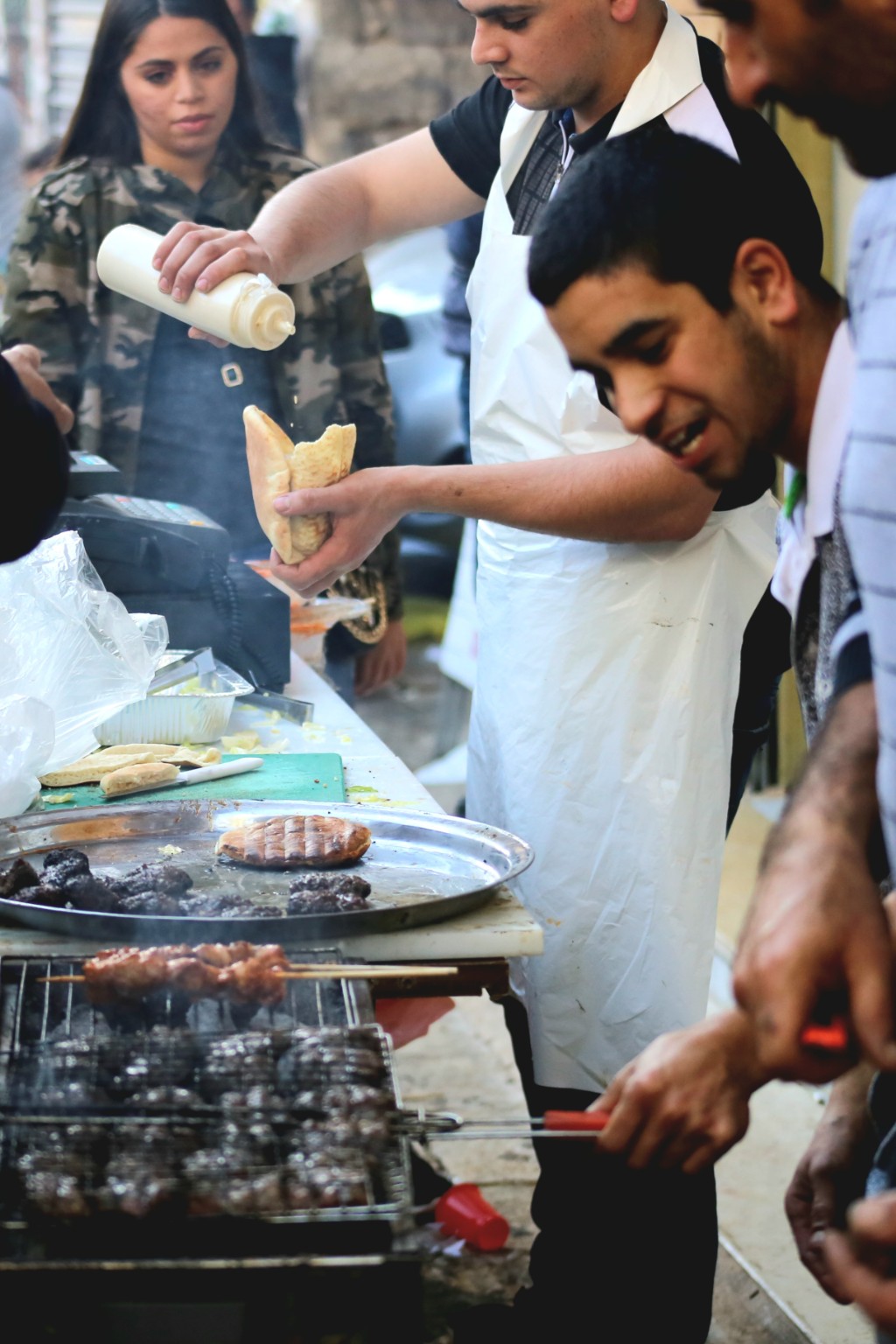
The photograph captures the wonderfully informal choreography of a street-food stall. A young vendor in a white apron holds open a pita while squeezing sauce into it. Another worker leans forward with a smile, tending the charcoal grill crowded with skewers of meat. A metal tray holds grilled patties and darker, heavily charred pieces. A woman in camouflage-patterned clothing watches from behind the counter. There is smoke, movement, concentration and the sort of cheerful disorder that tends to accompany good street food. Nobody is arranging a restaurant plate with tweezers. Food is being prepared to be eaten, probably within seconds.
What makes the scene particularly appealing is the relationship between the bread and the grill. The meat may be the expensive ingredient, the reason customers stopped in the first place, but the pita makes everything work. It receives the hot kebab, catches the juices, accommodates chopped salad and provides a convenient place for tahini, hummus, pickles or a generous spoonful of something fiercely spicy. In Israel, that might be zhug, the Yemeni-inspired green or red chili condiment that can turn an ordinary sandwich into a rather memorable experience.
And peppers deserve special attention here. Fresh hot peppers, pickled chilies, roasted red peppers, spicy tomato salads and chili sauces all find a natural home inside pita. The bread softens their aggression without erasing their character. A hot pepper eaten alone can overwhelm the palate; tucked into warm bread alongside grilled meat and vegetables, it becomes part of a larger conversation between heat, acidity, fat and texture.
Pita also has a social advantage that is easy to overlook. It is democratic food. A worker on a lunch break, a student with limited money, a family at an outdoor market and a tourist exploring an unfamiliar neighborhood can all stand at the same counter and order essentially the same meal. The fillings may change with geography and income, but the underlying format remains reassuringly familiar.
Across the Middle East and Mediterranean, flatbreads have developed into an astonishing variety of everyday eating utensils. Some are thin and flexible, others thick and fluffy, and not every pita forms a pocket. Yet the principle is remarkably consistent: bread is not merely an accompaniment to food. It is part of the eating mechanism itself.
Of course, pita has its weaknesses. Overfill it and the bottom may split. Add too much sauce and gravity becomes an enemy. A poorly baked pita can tear at the first attempt to open it. And there is always the familiar moment when a particularly ambitious combination of kebab, salad, pickles and tahini begins escaping down someone’s wrist.
But these are minor engineering defects in an otherwise brilliant invention. In fact, a little mess is almost part of the pleasure. Street food should not always behave like a carefully controlled laboratory experiment.
Perhaps the greatest achievement of pita is that it makes packaging disappear. The wrapper is not something to discard after the meal. It is the meal. It absorbs flavor, contributes texture and disappears along with its contents. In an age increasingly concerned with disposable packaging, this ancient solution feels unexpectedly modern.
Watching a busy grill stall at work, it becomes clear that the best street-food inventions are often the simplest. Fire cooks the meat. A knife cuts the vegetables. A squeeze bottle delivers the sauce. And a humble piece of bread brings everything together.
Pita does not need reinvention. It has already solved the problem rather elegantly.